Ill-Posed

Mathematics is a subject for the young

[This is a guest post by Tristan Buckmaster. This blog post was initially written in a different file format and converted using AI. — T.] This blog post expands on a theme mentioned at the end of my recent talk at the Institute for Advanced Study on October 19. I would like to thank Matei […]

blog — Terence Tao
21 Oct 2026
#mathematical-research #mathematics-culture #academic-careers
Paralysis

“We study mathematics for pretty much the same reasons that we study astronomy. The stars and planets are already out there, and, despite millennia of human observation, there is more we don’t know about them than we do. […]”

blog — Proofs and Prompts
21 Oct 2026
#research-methodology #mathematical-philosophy

Mathematics of the Future

“Rapid advances in AI are transforming research, and for the growth of mathematical knowledge, this is thrilling. For our profession, however, this raises critical questions: Will there be a role for human mathematicians to play? How should mathematicians be trained and evaluated? […]”

blog — Proofs and Prompts
21 Oct 2026
#ai-mathematics #mathematical-practice #professional-concerns

The Power of Beauty and Elegance

What machines have: colossal knowledge and massive compute power. What humans have: intuition for beauty and elegance. The ultimate question is whether colossal knowledge and massive compute power wins over human intuition. If no, we only face some big changes. If yes, then human mathematics will degrade into exotic art.

blog — Proofs and Prompts
21 Oct 2026
#ai-assisted-mathematics #mathematical-philosophy #human-ai-collaboration

An experimental AI-math challenge: using tenth discriminant bounds to explore arguments ruling out Siegel zeroes

In the spirit of my recent “Math 2.0” talk on new ways to use AI assistance to enhance the human understanding of mathematics, rather than substitute for it, I am using this post to propose an experimental challenge, inspired by the recent activity around excluding Landau–Siegel zeroes, as discussed in this previous post. There is […]

blog — Terence Tao
20 Oct 2026
#analytic-number-theory #ai-assisted-research #experimental-mathematics

Who will become the new mathematicians of Math 2.0?

“I am mathematics PhD student. Up until recently, I fully intended to pursue a career in academic research. I deeply love mathematics, and I entered graduate school because of this. However I have made the decision to leave academia once I finish my doctorate and I am heartbroken; I would like to explain why. […]”

blog — Proofs and Prompts
20 Oct 2026
#mathematics-education #mathematics-profession #academic-career

A critique of the mathematical economy

We present a theoretical framework to understand mathematics, and the disruptive effect of AI in our field. Treating mathematics as an economy, we borrow ideas from the theory of value to uncover the hidden dynamics of prestige, attribution, and the job market.

blog — Proofs and Prompts
20 Oct 2026
#academic-culture #ai-mathematics-interaction #mathematical-philosophy

Letter to a worried student

I don't know how it will all turn out, so I certainly can't promise you anything. But I do know that “understanding” is a human activity — something computers cannot do for us (even if they solve problems better than we do, it serves no purpose unless there are humans who actually understand).

blog — Proofs and Prompts
20 Oct 2026
#ai-mathematics #philosophy-of-mathematics #mathematics-education
original
20 Oct 2026
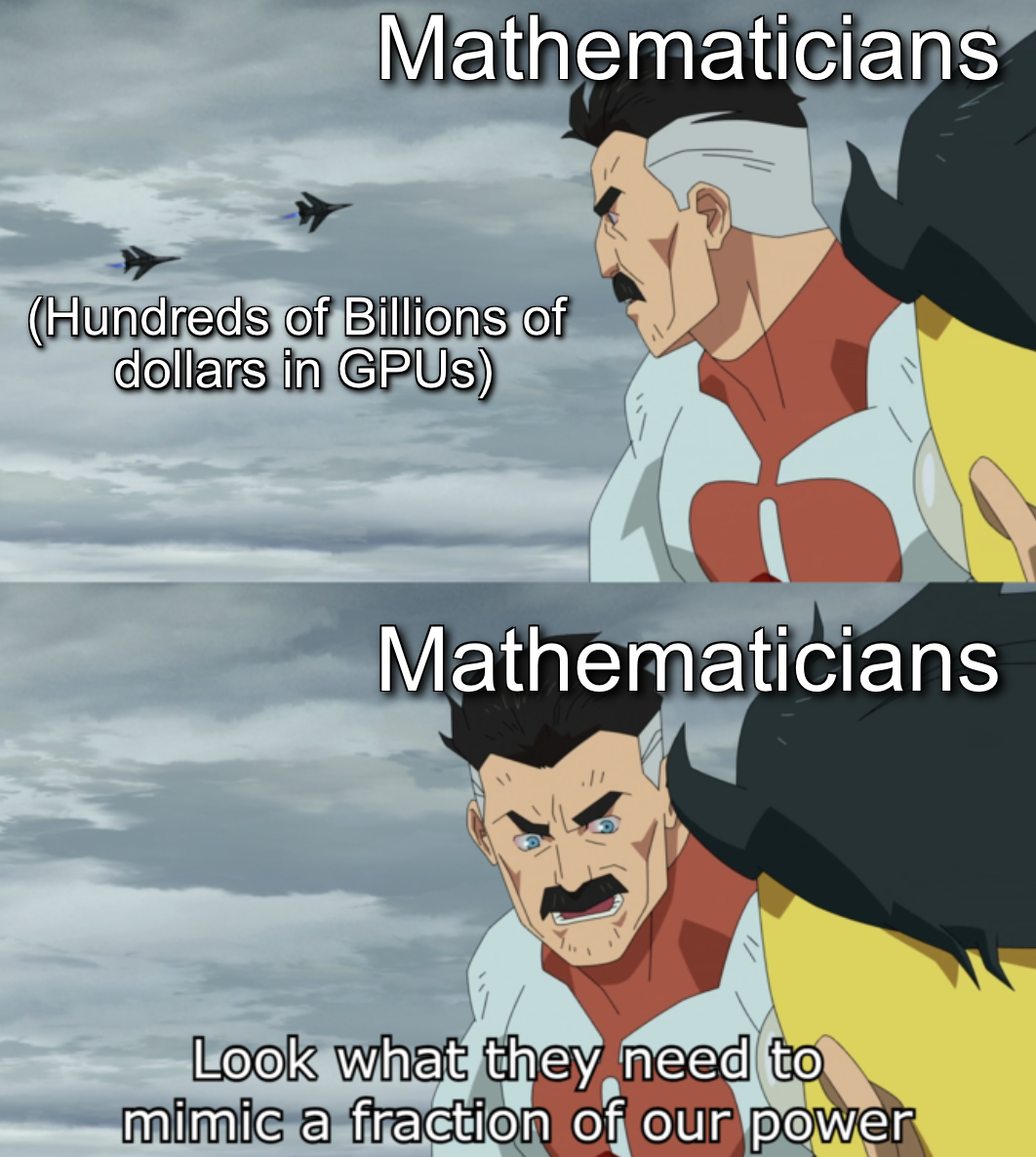
#billions #gpus #ai companies #mathematicians #invincible #superpowers

A sketch of the proof of non-existence of Siegel zeroes

For a given prime , the Legendre symbol is defined as follows: if is a quadratic residue modulo , then ; if is a quadratic non-residue modulo , then ; and if divides , then . Let be an integer that is not a perfect square. (One could require to be a fundamental discriminant if […]

blog — Terence Tao
19 Oct 2026
#analytic-number-theory #dirichlet-characters #siegel-zeroes

Does anyone else find it offensive that the same rich, influential #math guys who are propping up this #LLM charade have…

Does anyone else find it offensive that the same rich, influential #math guys who are propping up this #LLM charade have now decided that we need to focus on the importance of teaching and other "soft" aspects of the field now that "AI has solved math"? Like the reason people accepted your use of money to dictate the direction of the field was because they thought (1) you were…

mastodon — Charlotte Aten
19 Oct 2026
#research-ethics #ai-in-mathematics #mathematical-culture

The Bourgain Project

[This is a guest post by Lukas Liehr, João Pedro Ramos and Mitchell Taylor – T.] We are launching the Bourgain Project, a community-driven initiative to revisit, expand upon, and explore the body of work of Jean Bourgain, one of the most prolific mathematicians of his time. The goal of this initiative is to develop […]

blog — Terence Tao
19 Oct 2026
#harmonic-analysis #combinatorics #mathematical-history

Recommendations on the use of AI for PhD students and supervisors

We provide a proposed set of guidelines for PhD students and their supervisors. Given that PhD students are the most affected, both professionally and psychologically, by the advent of AI in mathematics, such guidelines, even if they may soon be obsolete, could be useful to them, their advisors and graduate schools.

blog — Proofs and Prompts
19 Oct 2026
#ai-in-mathematics #mathematical-education #professional-practice

OpenAI, Anthropic and the Simons Institute have promised to contribute enough money to pay a typical US math postdoc to…

OpenAI, Anthropic and the Simons Institute have promised to contribute enough money to pay a typical US math postdoc to work for 2 months on each of the 719 papers OpenAI recently released: 15,000,000/(719×15,000,000/(719 × 125,000) ≈ 1/6 where $125,000 is typical annual salary + benefits + overhead.

mastodon — John Carlos Baez
19 Oct 2026
#mathematical-research #funding #ai-mathematics-collaboration

Contribution, Credit, and Community

“This note is based on the assumption that the adoption of AI in mathematics is already inevitable. To paraphrase the principle of Chekhov’s gun, if we strive to resolve a conjecture while inhabiting a world that contains a button that, if pressed, will promptly resolve said conjecture, someone will indeed press the button. […]”

blog — Proofs and Prompts
19 Oct 2026
#philosophy-of-mathematics #ai-in-mathematics #mathematical-practice

Thinking Hard Above AI

There are many ways in which AI is generating uncertainty in mathematics. We are not sure how it will impact our jobs, it is raising questions about how it might affect academic training, and it is not clear how it might change the job search process and how we evaluate research. This is by no means an exhaustive list. In this post, I will focus two another related questions, which are: “Is there…

blog — Proofs and Prompts
19 Oct 2026
#mathematics-profession #ai-mathematics-interaction #research-evaluation

I've been thinking about the AI generated mathematical proofs thing and I actually feel like I'm not as bothered about i…

I've been thinking about the AI generated mathematical proofs thing and I actually feel like I'm not as bothered about it as I was initially.

provided of course that in the process of adding an AI generated proof to the corpus of true mathematical statements humans are still checking the work.

bluesky — Taka Hanazawa
18 Oct 2026
#ai-aided-mathematics #philosophy-of-mathematics #mathematical-proof

Two months of Proofs and Prompts: Forum, polls and moderation

“It has been two months since we started Proofs and Prompts. Once again thanks everyone for making it an active platform, we hope the conversations happening here will help build what mathematics will look like tomorrow. We take advantage of this new post to announce two new features that we would like to launch: […]”

blog — Proofs and Prompts
18 Oct 2026
#community #mathematical-practice

Will it be a golden age or a dark age for mathematics (and science)?

[This is a guest post by Francesco Maggi. This blog post was initially written in a different file format and converted using AI. — T.] Large language models (LLMs) and the research systems built around them (and commonly known as “artificial intelligence”) have demonstrated remarkable abilities in generating mathematical proofs. While the quality and limits […]

blog — Terence Tao
18 Oct 2026
#large-language-models #ai-mathematics #mathematical-proof

Who Will Lead Mathematical AI?

“A small episode from this summer keeps coming back to me. At the National Academies meeting Organizing Mathematical Knowledge in the Age of AI and Formalization, David Spergel discussed Japan’s participation in the Department of Energy’s Genesis Mission. […]”

blog — Proofs and Prompts
18 Oct 2026
#ai-mathematics #formalization #research-policy

Mathematics in the Dark Forest

An open problem list is a bullseye painted on your field.

blog — Proofs and Prompts
18 Oct 2026
#open-problems #mathematical-culture

Starting a new journal

[This is a guest post by Shaoming Guo – T.] Several math colleagues and I are preparing to launch a new journal. As we considered which values we wanted the journal to uphold, we realized that there may be many other values worth exploring as a community, potentially through the creation of additional journals. We […]

blog — Terence Tao
18 Oct 2026
#academic-institutions #mathematics-publishing #research-community

Some of my recent talks and interviews

As readers of this blog have no doubt noticed, I have recently turned over the majority of content on this blog to guest posts from other authors, either within the mathematics community or adjacent to it. In this post I record some content coming from my own talks and interviews in this time period. “The […]

blog — Terence Tao
17 Oct 2026
#mathematics-community #research-dissemination

The more you panic the more you feed the pyschic beast

“Some of our chats with AI can become training data. Even without another breakthrough in AI methods, a simple magic trick is possible: a machine connects ideas from mathematicians who have never spoken to one another and produces a solution. […]”

blog — Proofs and Prompts
17 Oct 2026
#ai-mathematics-interaction

Parallelize AI and Human Understanding, and Other Thoughts

“AI for math is a hot topic right now, as it has shown to be powerful but also controversial in many ways. This is a summary of my thoughts regarding the most prominent discussion points today: […]”

blog — Proofs and Prompts
17 Oct 2026
#ai-assisted-mathematics #mathematical-reasoning #ai-and-math

SAIR Open Math OS released

As announced a few weeks ago, the SAIR Open Math OS is now soft launched. It offers services and web interfaces similar to frontier AI models, though currently we are hosting existing open math models (DeepSeek V4.1 Flash, Kimi K3, and GLM 5.3 Flash) which are roughly a year or so behind the current frontier […]

blog — Terence Tao
16 Oct 2026
#large-language-models #ai-mathematics #mathematical-computation

Can AI help with the most tedious, time-consuming parts of formal verification?

Can AI help with the most tedious, time-consuming parts of formal verification?

In a recent experiment, Galois's Marios Georgiou explored "proof grinding" with LLMs. The strongest results came when the LLM received one precise property to prove or break at a time.

bluesky — Galois
16 Oct 2026
#formal-verification #llm-applications #automated-reasoning

How to Formalize All of Mathematics

Jeremy Avigad, Kevin Buzzard, Johan Commelin, Rémy Degenne, Kim Morrison, Oliver Nash and Adam Topaz have written a blog post over on Kevin Buzzard’s blog entitled “How to Formalize All of Mathematics”, regarding recent proposals to automatically formalize the entirety of the mathematical literature. The issues regarding formal mathematics are parallel to those regarding informal […]

blog — Terence Tao
16 Oct 2026
#proof-verification #mathematical-foundations #formal-methods

Many people just starting out on Lean formalization have enjoyed playing the Natural Numbers Game. Now Autumn Mapes has…

Many people just starting out on Lean formalization have enjoyed playing the Natural Numbers Game. Now Autumn Mapes has produced Visual Lean, isomorphic to the original but playable in a lovely intuitive way with clicking and dragging rather than typing.

leangame.autumnofautumn.com

bluesky — Timothy Gowers
16 Oct 2026
#proof-assistants #formal-verification #mathematical-education

On AI statements in mathematics papers

“Over the past year, many people have written eloquently and at length on the continuously improving power of generative AI (Large Language Models or LLMs) for research mathematics. Opinions range over the entire spectrum from negative to positive, but all seem to agree that mathematics is going through a period of enormous change […]”

blog — Proofs and Prompts
16 Oct 2026
#large-language-models #ai-assisted-mathematics #mathematical-practice
← newerpage 2 of 19older →